Most founders I speak with are not short of expertise. They have done the work for years. Their clients trust them. People in their network refer them. And yet, outside that circle, almost nobody knows who they are or what they stand for.
That gap is what authority positioning is meant to close. Not by making you louder, but by making it clear to the right buyers why your view on a problem deserves their attention, and their trust, before they ever speak to you.
In this guide I explain what authority positioning is, how it differs from personal branding and thought leadership, what the research says about why it matters, and a practical way to build it without pretending to be something you are not.
The short answer: authority positioning is the work of making your expertise clear, proven and visible enough that the right buyers see you as the obvious choice in your field. It is earned through evidence and useful ideas shared consistently, not by calling yourself an expert.
What is authority positioning?
Authority positioning is the deliberate work of making a founder, expert or company the most credible answer to one specific problem in the minds of one specific audience. It combines a clear position (who you help and with what), a distinct point of view, and visible proof that your thinking works.
The idea builds on classic positioning theory. Al Ries and Jack Trout argued in Positioning: The Battle for Your Mind that positioning happens in the mind of the buyer, not in the product. Authority positioning applies the same logic to expertise. The question is not “Are you an expert?” It is “When a buyer has this problem, whose name comes to mind first, and why do they believe that person?”
Authority positioning vs personal branding vs thought leadership
These three terms are often used as if they mean the same thing. They do not.
| Personal branding | Thought leadership | Authority positioning | |
|---|---|---|---|
| Main question | How am I perceived? | What ideas am I sharing? | Why am I the credible choice for this problem? |
| Focus | Identity, visibility | Content and ideas | Position, proof and market preference |
| Typical risk | Visible but vague | Smart content with no clear owner of a problem | Claiming authority before earning it |
| Success looks like | Recognition | Engagement and reach | Being shortlisted and referred |
Thought leadership is one of the tools you use. Personal branding is part of the outcome. Authority positioning is the strategy that decides what both should achieve. I explore the first distinction in more detail in Personal Branding vs Positioning.
Why does authority positioning matter for B2B founders?
Because buyers use your thinking to judge your capability, often long before they contact you.
The 2024 Edelman–LinkedIn B2B Thought Leadership Impact Report surveyed 3,484 business decision-makers across the US, UK, Canada, Germany, Singapore, Australia and India. Three findings stand out:
- 73% said an organisation’s thought leadership is a more trustworthy basis for assessing its capabilities than its marketing materials.
- 86% said they would be moderately or very likely to invite an organisation to an RFP if it consistently produced high-quality thought leadership.
- Yet only 15% rated the thought leadership they read as very good or excellent.
Read together, this tells me two things. Buyers do use ideas as evidence. And most of what they read does not meet the bar. The opportunity is not to publish more. It is to publish thinking that is clearly yours, clearly useful and clearly connected to a problem you solve.
Behavioural science points the same way. Robert Cialdini’s principle of authority describes how people tend to follow credible, knowledgeable experts. One example shared by Influence at Work describes an estate agency where reception staff introduced colleagues with their actual experience before transferring calls. The firm reported a 20% rise in appointments and a 15% rise in signed contracts. Nothing about the agents changed. Only how clearly their credibility was signalled.
The founder authority journey
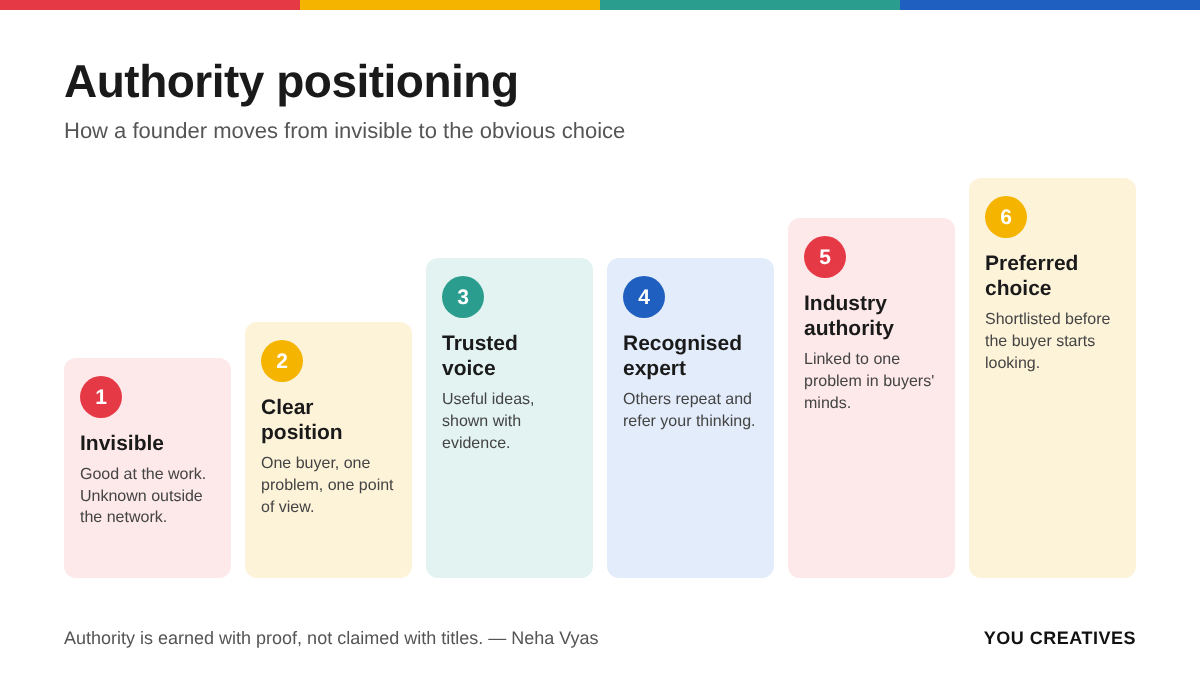
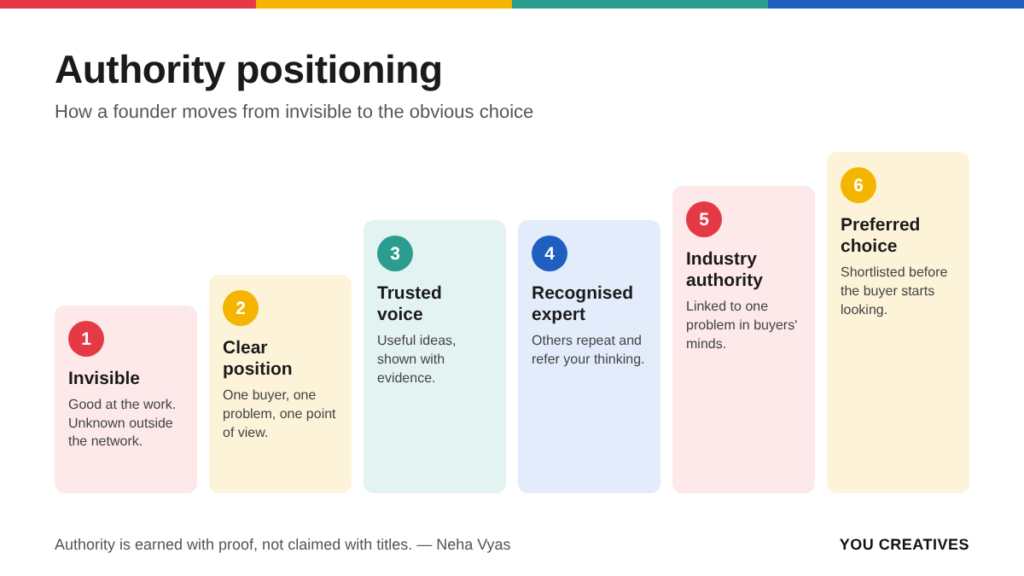
At You Creatives we think of authority as a progression, not a label you give yourself:
- Invisible. Good at the work, unknown outside your network.
- Clear position. One buyer, one problem, one point of view.
- Trusted voice. You share useful ideas and show the evidence behind them.
- Recognised expert. Others start to repeat, reference and refer your thinking.
- Industry authority. Your name becomes linked to one problem in buyers’ minds.
- Preferred choice. You are shortlisted before the buyer starts looking.
Most founders try to jump from step one to step three. They start posting before they have decided what they want to be known for. The result is visibility without recognition. People see you, but they cannot say what you are the answer to.
How to build authority positioning in 5 steps
If you would rather not do this alone, see how we work as a personal branding consultant.
1. Choose the problem you want to own
Authority is always specific. “Marketing expert” is a category. “The person who helps Nordic B2B SaaS founders find their first enterprise buyers” is a position. Pick the problem where your experience is deepest and where buyers feel real pain. If you are unsure, look at your last ten best clients and ask what they had in common when they found you.
2. Define your point of view
Expertise explains how things work. A point of view explains what most people get wrong and what you would do instead. Write it in one or two sentences. If a competitor could say the same thing without changing a word, it is not yet a point of view.
3. Collect proof before you amplify
Authority is earned with proof, not claimed with titles. Proof can be client results, case studies, original research, a framework you actually use, or a clear before-and-after story. Be honest about scale. A small, specific, true example builds more trust than a big, vague claim.
4. Show your thinking where your buyers already look
Choose two or three places your buyers actually spend attention: LinkedIn, a niche newsletter, industry podcasts, events, or your own website. Then show how you diagnose problems, not just what you sell. Explanations of real cases, mistakes and trade-offs do more for authority than motivational posts. If posting every day feels wrong for you, it does not have to be daily. Consistency of message matters more than frequency.
5. Make sure the founder and the company say the same thing
If your personal content talks about one problem and your company website sells another, buyers get confused. Authority built by the founder should point clearly towards what the business offers. I cover this in Business vs Founder Positioning.
Does authority positioning help you appear in AI search?
It is likely to help, although no one can guarantee how AI tools will describe a company. Generative engines such as ChatGPT, Perplexity and Google’s AI Overviews draw on what is published about you. If your website, your content and what others write about you consistently connect your name with one problem, those tools have a clearer signal to work with. If your message changes from channel to channel, they have a weaker one.
In practice this means:
- Use the same clear description of who you help and what you solve on your website, LinkedIn and bio.
- Answer the real questions buyers ask, in plain language, on pages they can find.
- Publish evidence: named examples, data with sources, and your own frameworks.
- Earn mentions from credible third parties, such as podcasts, partners and publications.
For more on this, read GEO and AEO Explained for Founders and How B2B Buyers Use AI to Research You.
Common authority positioning mistakes
- Declaring authority instead of demonstrating it. Calling yourself “a leading expert” does not make buyers believe it. Showing your reasoning does.
- Being known for too many things. Breadth feels safe, but it makes you harder to remember and harder to refer.
- Measuring followers instead of conversations. Engagement is a signal, not the outcome. The outcome is the right people asking to talk to you.
- Copying a US playbook for a different market. In many Nordic and European business settings, understated proof tends to land better than bold self-promotion. Test what works with your own buyers instead of assuming.
- Starting with content instead of strategy. Visibility without strategic clarity creates noise.
Frequently asked questions
What is the difference between authority and credibility?
Credibility means buyers believe you can do the work. Authority means they see you as a leading reference on a specific problem. You need credibility first. Authority comes when that credibility becomes visible and consistent over time.
How long does it take to build authority positioning?
There is no fixed timeline. It depends on how specific your position is, how much proof you already have and how consistently you show up. A clear position can be defined in weeks. Being recognised by a market usually takes much longer, and anyone promising fast authority is selling visibility, not trust.
Can a new founder build authority without years of experience?
Yes, if they are honest about where their credibility comes from. A new founder can build authority on a narrow problem through original research, customer insight and transparent learning. What they should not do is borrow authority they have not earned.
Is authority positioning only for founders?
No. It applies to consultants, advisors, executives, specialists and companies. The principle is the same: be the clearest and most credible answer to one problem for one audience. See also Personal Branding for Consultants.
A final thought
People rarely choose the objectively best expert. They choose the one they understand, trust and remember. Authority positioning is how you make sure that, when the right buyer has the problem you solve, that person is you.
If you want help defining your position and building authority on evidence rather than noise, take a look at founder positioning at You Creatives.