
Most personal branding advice is a pile of disconnected tactics: post more, network more, get on podcasts, write a book. None of it is wrong, exactly, but without a structure underneath it, it’s just noise dressed up as strategy. We built the 4A Framework because founders don’t need more tactics — they need a sequence.
Attract
Before anyone can find you, you need clarity on who you’re actually trying to reach and why they should care. This stage is about defining your ideal audience and the specific problem you solve for them — not in vague mission-statement language, but in words your actual clients would recognize as true.
Articulate
This is where founder narrative, brand story, and positioning get built. Not a highlight reel of achievements, but an honest account of what you believe, what you’ve learned, and what makes your approach different. This is usually the stage founders resist most, and the one that matters most once they get through it.
Amplify
With a clear story in hand, this stage is about visibility — LinkedIn, thought leadership, PR, podcasts, speaking. Not everywhere at once, but on the one or two channels where your actual audience already pays attention.
Activate
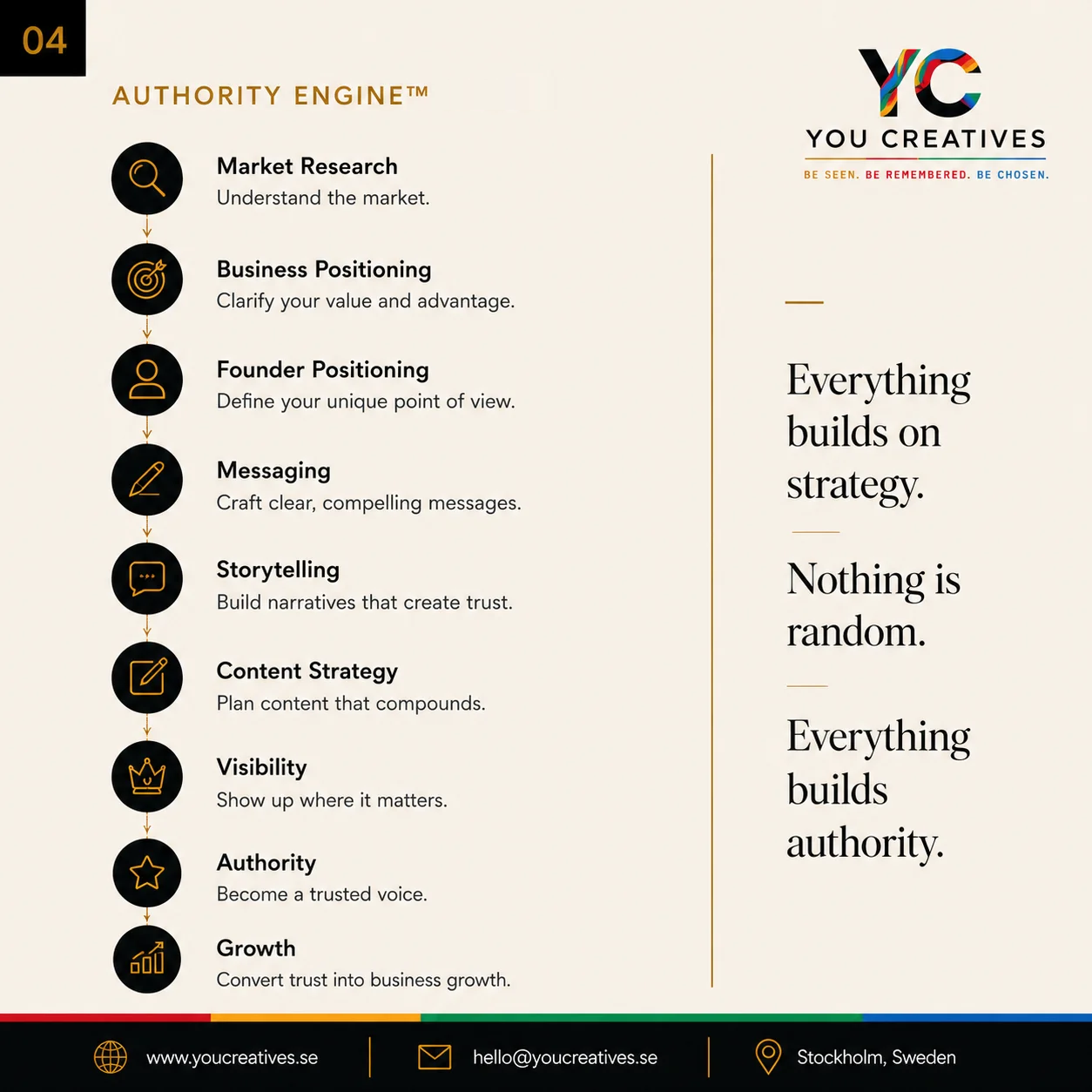
The final stage turns visibility into outcomes: content, case studies, pitch narratives, and a digital presence built to convert attention into trust, and trust into chosen. This is where the 4A Framework plugs into the Authority Engine™ — the nine-stage system, from market research to growth, that keeps the whole thing running without you having to reinvent it every month.
Each stage depends on the one before it. Skip Articulate and jump to Amplify, and you’re amplifying a story that isn’t clear yet — which is why so much founder content feels hollow. Do the stages in order, and visibility stops feeling like performance and starts feeling like the truth, just said out loud.
Want to see where you currently sit in the framework? Book a free consultation and we’ll map it with you.
Why a framework at all
Most founder visibility work fails not because any single tactic is wrong, but because the tactics arrive in the wrong order. Someone starts posting three times a week before they have decided what they stand for. Someone else spends four months perfecting positioning and never publishes it. Both end up with nothing.
The 4A Framework exists to fix sequence. Each stage produces an output the next stage consumes. Skip one and the later stages have nothing to work with.
Attract — find the position worth owning
Attract is not about audience growth. It is the diagnostic stage: who specifically are you for, what do they already believe, and what is the one thing you can credibly claim that your competitors cannot?
The work here is uncomfortable because it involves subtraction. A founder who is “for founders” is for nobody. A founder who is “for solo, mission-led founders in Sweden who find self-promotion culturally difficult” has a position — narrow enough to be memorable, specific enough that the right person recognises themselves immediately.
What this stage produces: a written positioning statement, a defined audience, and a short list of the two or three themes you will own. Nothing gets published until these exist.
The most common mistake at this stage
Choosing a position based on what feels most impressive rather than what is most defensible. Impressive positions attract applause; defensible positions attract clients. If five competitors could make the same claim, it is not a position.
Articulate — turn the position into language
A position that only exists as a concept is useless. Articulate converts it into the actual sentences you will use — in your headline, your About section, your first line on a sales call, and the way you explain your work at a dinner party.
This is where founder narrative work happens: the origin story, the point of view, the set of specific opinions that distinguish you. It is also where most Nordic founders need the most help, because the instinct to hedge shows up strongest at exactly the moment clarity matters most.
What this stage produces: a message architecture — one core statement, three supporting themes, and a bank of specific stories and examples you can reach for repeatedly without repeating yourself.
The test for good articulation
Can a client explain what you do to someone else, accurately, without you present? If not, the language is not finished. Most founders discover their positioning is unclear the first time they hear a happy client describe them wrongly.
Amplify — put it in front of people, consistently
Only now does publishing make sense. Amplify is the distribution layer: which channels, what cadence, what formats, and what gets repurposed where.
The principle that matters most here is consistency over intensity. A founder publishing one considered piece a week for a year will be substantially better known than one who publishes twenty pieces in a month and then stops. Search engines and audiences both reward the same thing — evidence that you are still here.
What this stage produces: a publishing rhythm you can actually sustain, a content system that turns one idea into several formats, and a small set of borrowed audiences — podcasts, newsletters, communities — where you appear regularly.
Owned, borrowed and earned
Owned channels are yours: your site, your newsletter, your profile. Borrowed are platforms you rent attention on. Earned is when someone else talks about you without being asked. Founders starting from zero should weight heavily towards borrowed early, because borrowed audiences convert to owned faster than owned audiences grow on their own.
Activate — convert attention into conversation
Visibility that produces no business is a hobby. Activate is the stage where attention becomes pipeline: clear calls to action, a way for interested people to raise their hand, and a follow-up process that does not depend on the founder remembering.
Most founders under-build this stage badly. They publish well, generate genuine interest, and then offer no route from “this was interesting” to “let’s talk.” The gap is usually a single missing sentence at the end of a post, or a contact page that asks for too much.
What this stage produces: a defined path from content to conversation, a lightweight offer that is easy to say yes to, and a simple way of tracking which content precedes real enquiries.
How long each stage takes
Attract and Articulate together typically take three to six weeks of real work — they are compressed, intense and mostly conversational. Amplify is ongoing and never finishes. Activate is built once and refined continuously.
The compounding does not start until Amplify is running consistently, which is why founders who spend six months perfecting positioning see no results. The framework is sequential, but the first two stages are meant to be fast.
Related reading
- What a Brand Audit Actually Finds
- Founder Narrative 101: Turning Your Origin Story Into a Sales Asset
- The Founder-Led Marketing Shift
- See the framework applied to your business
Frequently asked questions
Can I start at Amplify if I already know my positioning?
Sometimes. The test is whether you can write your positioning in one sentence and whether three clients would describe you the same way. If either fails, start earlier.
How is this different from a normal marketing strategy?
A marketing strategy usually starts with the company. This starts with the founder — their expertise, their point of view, their credibility. For businesses where the founder is the product, that order produces very different answers.
What if I’m not the only founder?
The framework still applies, but you run Articulate separately for each visible founder while keeping Attract shared. Two founders with distinct voices and one aligned position is stronger than two founders saying identical things.