
Most “about me” pages read like a résumé wearing a friendly font. Dates, titles, a vague mission statement. None of it moves anyone, because none of it is actually a story — it’s a list.
What makes a narrative work
A founder narrative works when it’s specific and honest about the moment something became unbearable enough to act on. Not the polished version where you always knew you’d start this company — the real version, with the doubt, the false starts, and the actual decision point. Specificity is what makes a story believable, and believability is what makes it persuasive.
Why this belongs in your sales process, not just your bio
A well-told founder narrative does real commercial work: it explains why you’re credible on this specific problem, it builds emotional trust before a single feature gets discussed, and it gives prospects a reason to choose you over a competitor with a similar offering and a forgettable story. People remember stories long after they’ve forgotten your pricing page.
The trap to avoid
Don’t sand the story down until it’s inspirational-poster smooth. The parts founders want to cut — the uncertainty, the wrong turns, the unglamorous grind — are usually the parts that make the story land. Authenticity, not polish, is what makes people trust you enough to buy.
Your story is already there. Most founders just need help finding the honest version and shaping it into something that works across your website, your pitch deck, and your LinkedIn profile. We’d like to help you tell it.
What an origin story is for
A founder story is not autobiography. Its job is to explain, in a way a stranger can absorb in ninety seconds, why you are a credible person to solve this specific problem — and why you are likely to still care about it in three years.
That means most of your actual history is irrelevant to it. The useful test for any detail: does it make the reader more confident that you understand their problem? If not, cut it, however meaningful it is to you personally.
The four parts that do the work
1. The problem you kept encountering
Start with the pattern, not with yourself. What did you keep seeing that bothered you? This opening does two things at once — it demonstrates that you have observed the problem repeatedly, and it lets the reader recognise themselves before you have said anything about your background.
2. Why the existing answers did not satisfy you
This is your positioning, delivered as narrative rather than as a claim. Explaining what you found inadequate about the standard approach communicates your point of view far more persuasively than stating it directly.
3. What you did about it
The turn. Short. This is where the business comes from, and it should feel like a consequence of the first two parts rather than an ambition that arrived independently.
4. What you believe now
The line the reader will remember and repeat. One sentence, stated without hedging. If a client can quote it back to you months later, the story is doing its job.
The details that make it land
One specific scene. A single concrete moment — a conversation, a room, a particular client’s question — anchors an abstract story in something real. Not three scenes. One.
An honest cost. Something the path actually cost you: money, a safer option, several years. Founder stories that contain no cost read as marketing. This is not about performing vulnerability; it is about being believable.
A number, if you have one honestly. How many people you spoke to, how long the pattern took to become obvious, how many attempts preceded the current version.
Where the story actually gets used
Founders write the story once, put it on an About page, and never use it again. That wastes most of its value. The narrative should be modular.
The full version lives on your founder page. A three-sentence version becomes your LinkedIn About opening. A single line becomes how you answer “so what do you do?” at an event. The specific scene becomes a standalone post. The belief statement becomes a recurring theme across everything you publish.
Written once, deployed in five places — and the repetition is a feature. Consistency across surfaces is what makes a story memorable rather than merely well written.
What to avoid
Chronology from birth. Lists of previous roles. Manufactured hardship. Claiming an epiphany that arrived fully formed — real founder stories are almost always about a pattern noticed gradually, and saying so is more credible than a lightning bolt.
And avoid making yourself the hero. The most effective founder stories position the reader’s problem as the subject and the founder as the person who happens to have studied it closely.
Related reading
- The 4A Framework: From Invisible to Category-Known
- How to Ghostwrite LinkedIn Posts That Sound Like You
- What a Brand Audit Actually Finds
- Work with us on your founder narrative
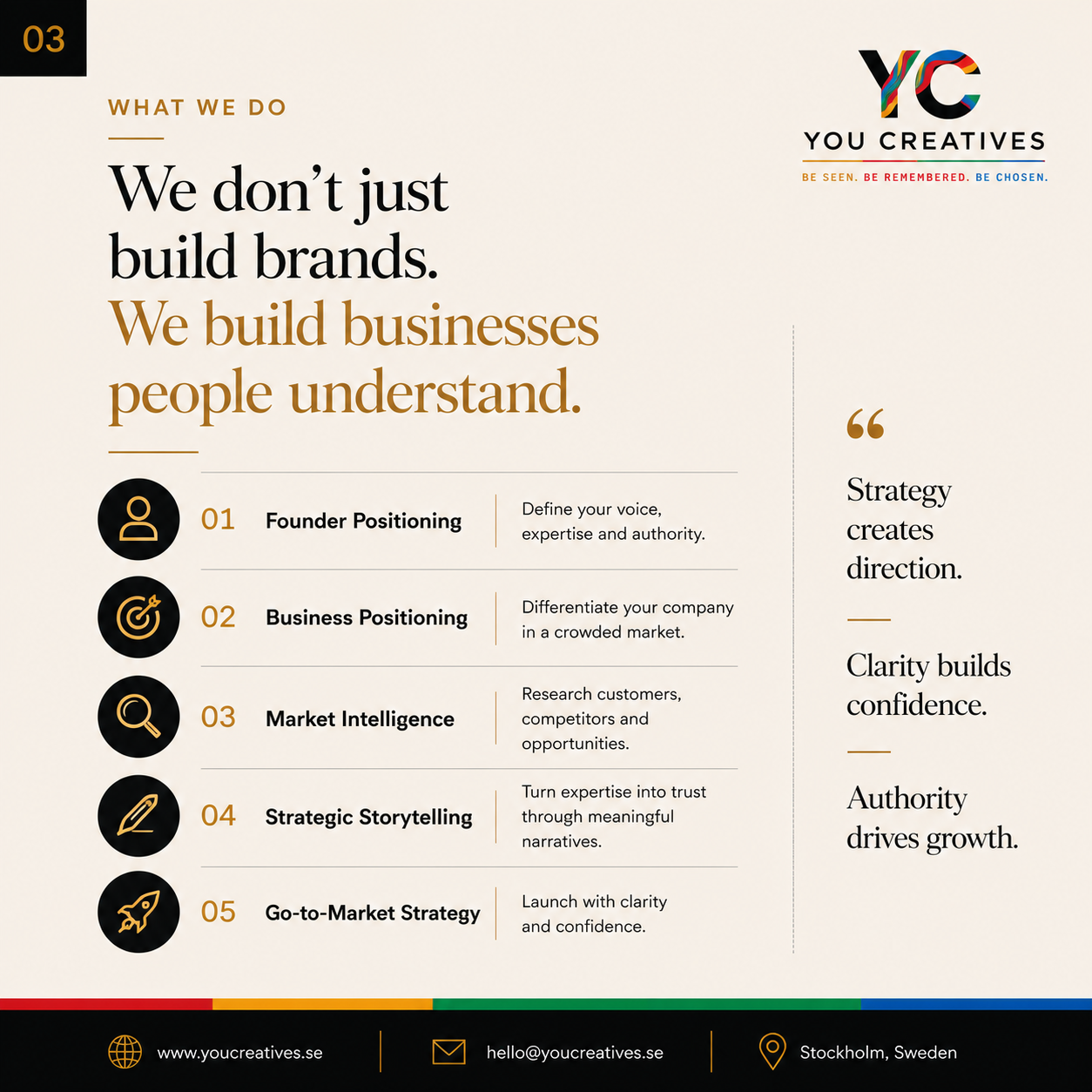 founder positioning, business positioning, market intelligence, strategic storytelling and go-to-market strategy” class=”wp-image-4727″ width=”1254″ height=”1254″ />
Frequently asked questions
How long should a founder story be?
The full written version, three hundred to five hundred words. Anything longer stops being a story and becomes a biography, and readers stop before the part that matters.
What if my origin isn’t dramatic?
Most are not, and that is fine. Credibility comes from specificity, not drama. “I noticed the same problem in nineteen client projects” is more convincing than a crisis narrative.
Should the story change over time?
The events do not, but the emphasis should. As your business narrows, the parts of the story that support the current positioning move forward and the rest recede.