Most value propositions I read could belong to almost any company in their category. “We help businesses grow.” “Innovative solutions, exceptional service.” Nothing in them is false. They just don’t give a buyer a reason to choose.
A good value proposition does one job. It tells the right buyer, quickly, why your offer is worth more to them than the next best option. That sounds simple, and it rarely is. Most teams try to say everything. The strongest value propositions say one or two things and prove them.
In this guide I will explain what a value proposition is, where the idea comes from, the three types of value propositions researchers have identified, and a six-step way to write your own. You will also find a free template, real B2B examples and the mistakes I see most often.
The short answer: here is how to write a value proposition. Pick one buyer in one situation, name what they would do without you, choose the one or two differences they care about most, show you are not worse on the basics, and put a number on the value. Then test it with real buyers before you publish it.
What is a value proposition?
A value proposition is a short, specific statement of why a particular customer should choose your offer over their next best alternative. It names who it is for, the outcome they get, what makes it different, and the proof that it is true.
It is not a slogan and it is not a list of features. It is a promise of value that a buyer can check.
Where does the term “value proposition” come from?
The term is usually credited to Michael Lanning and Edward Michaels, who used it in a 1988 McKinsey staff paper. McKinsey later published their thinking in its Quarterly as part of an article called Delivering Value to Customers. They described a value proposition as “a clear, simple statement of the benefits” a company will provide, both tangible and intangible, together with the approximate price for each customer segment.
Two parts of that early definition are often forgotten. First, it is written for a specific segment, not for everyone. Second, it includes price. Value is always relative to what the customer pays and what else they could choose.
Value proposition vs positioning statement vs tagline
These three are often mixed up. They are related, but they do different jobs.
| What it is | Who reads it | Example of where it lives | |
|---|---|---|---|
| Positioning statement | The internal decision about who you are for, what you compete with and why you win | Your team | Strategy document, brief for your website or agency |
| Value proposition | The promise of value a buyer reads, built from that decision | Your buyer | Homepage headline and subhead, first slide of a sales deck, LinkedIn About section |
| Tagline | A short, memorable line that carries the brand | Everyone | Logo lock-up, campaign, signature |
Write the positioning first, then the value proposition. I explain why in Positioning Statement vs Value Proposition: Which One to Write First.
What are the three types of value propositions?
The most useful research I know on this comes from James Anderson, James Narus and Wouter van Rossum. In their 2006 Harvard Business Review article, “Customer Value Propositions in Business Markets”, they described three types of value proposition that companies use.
| Type | The question it answers | The risk |
|---|---|---|
| All benefits | Why should a customer buy this? | Listing benefits that don’t matter to the customer (the authors call this “benefit assertion”) |
| Favourable points of difference | Why should they buy this instead of a competitor’s offer? | Assuming a difference is valuable without checking (“value presumption”) |
| Resonating focus | What is most worth remembering about this offer? | Needs real customer research to get right |
The authors call resonating focus the gold standard. It concentrates on the one or two differences that create the most value for the target customer, and it shows and documents that value. In their words, “more is not better.”
This is the single most important idea in this guide. A value proposition gets stronger when you remove things, not when you add them.
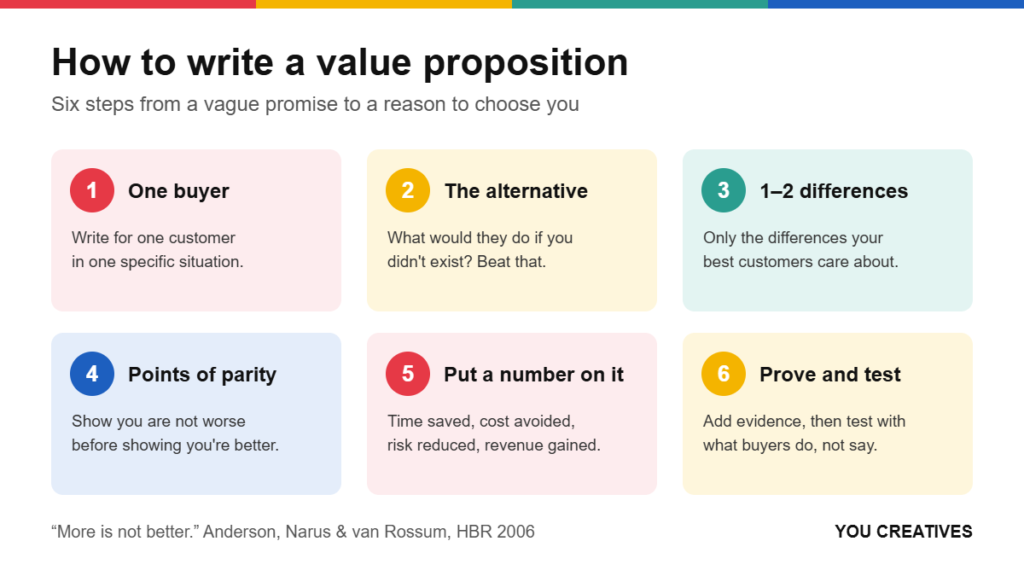
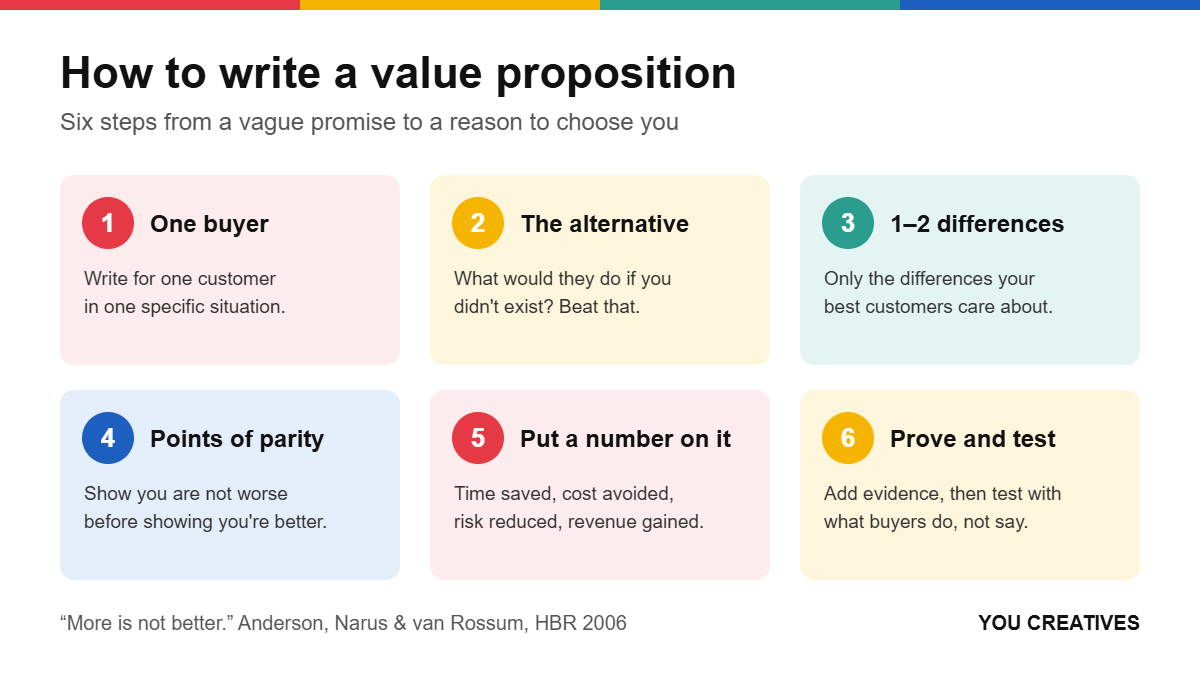
How to write a value proposition in 6 steps
If you have not spoken to buyers yet, start with customer discovery interviews.
1. Choose one buyer and one situation
Write for a specific customer in a specific moment. “Founders” is too broad. “Founders of B2B software companies with a working product who are preparing their first sales hires” is something you can write for. If you serve several segments, write one value proposition for each.
2. Name the next best alternative
Value is always compared with something. Ask what the customer would do if you did not exist. Often it is not another company. It is a spreadsheet, an internal team, a freelancer, or doing nothing at all. Your value proposition has to beat that option, not an imaginary average competitor.
3. Find the one or two differences that matter most
List everything that is different about your offer. Then cut it down to the one or two differences your best customers care about most. Don’t guess. Look at why recent customers chose you, what they compared you with, and what they say in their own words. Sales calls and short customer interviews are usually enough to start.
Be honest about which “differences” are really category expectations. Good service, experience and quality are things buyers assume. They rarely decide a choice on their own.
4. Keep your points of parity
Anderson and his co-authors also stress points of parity: the things you do as well as the alternative. Buyers often need to know you are not worse before they care that you are better. Their example from packaging supplier Sonoco shows this. When it redesigned packaging for a large European consumer goods company, its value proposition stressed one point of parity and two points of difference, rather than a long list of benefits.
5. Put a number on the value
Where you can, express the difference in the customer’s terms: time saved, cost avoided, risk reduced, revenue gained. The HBR authors describe a “value word equation”, a simple formula in words that shows how a difference turns into money. Rockwell Automation used one for energy savings: power used, multiplied by operating hours, cost per kWh and years in operation, comparing its result with the competitor’s.
You do not need a complex model. A clear, honest estimate the buyer can check is worth more than a big claim they cannot.
6. Prove it, then test it
A value proposition without evidence is an opinion. Add proof: a customer result, a documented case, a guarantee, a pilot, a demo. GE’s water and process technologies business, one of the examples in the HBR article, had documented more than 1,000 customer case histories at the time.
Then test the wording with real buyers before you launch it widely. Compliments are weak evidence. Behaviour is stronger: replies to outreach, booked calls, clicks on a landing page, what people repeat back to you after reading it. I explain simple ways to do this in How to Test Your Messaging Before Launch Without a Research Panel.
A free value proposition template
Use this as a working draft. Fill in each line, then turn it into one headline and one supporting sentence.
- For: [one specific buyer] who [situation or trigger]
- Instead of: [their next best alternative, including doing nothing]
- We help them: [the outcome they care about most]
- Because we: [the one or two differences that matter most]
- Without: [the pain or risk they want to avoid]
- Proof: [a number, a result, a case or a guarantee]
Worked example (illustrative, not a real company): an accounting firm for Swedish startups.
- For: founders of Swedish startups preparing their first funding round
- Instead of: a general accounting firm and a separate financial consultant
- We help them: arrive at investor meetings with numbers they can defend
- Because we: combine bookkeeping with investor-ready reporting in one monthly package
- Without: last-minute clean-up work before due diligence
- Proof: [your real client results here]
Headline: Investor-ready numbers for Swedish startups, every month.
Subhead: Bookkeeping and funding-round reporting in one package, so due diligence is never a scramble.
Notice what is left out. No “innovative”, no “passionate team”, no list of ten services. One buyer, one outcome, one difference.
B2B value proposition examples from research
Most online examples come from consumer brands. In B2B, buyers compare more carefully and need more proof. These examples come from the 2006 HBR research by Anderson, Narus and van Rossum, so they are dated, but the lessons still hold.
- Quaker Chemical guaranteed an automotive engine manufacturer savings of five times its annual coolant spend, which came to $1.4 million a year. A guarantee is one of the strongest forms of proof.
- A specialty resins supplier found through research that labour was most of a painting contractor’s cost, while coatings were about 15%. Its new resin allowed two coats in one shift, and it earned a 40% price premium. The value was in the customer’s labour, not in the product itself.
- An integrated circuit supplier faced a competitor that was 10 cents per unit cheaper. The customer’s own model valued the supplier’s offer at 15.9 cents more per unit, yet the salesperson offered a 10-cent discount anyway. Across 5 million units, that left at least half a million dollars on the table. If you don’t know your value, you will give it away.
- A gas chromatograph maker promoted “sample integrity” to commercial labs, which turned out not to need it. This is benefit assertion in action: a real feature, but not a reason to buy.
How to write a value proposition for a business plan
In a business plan, the value proposition is a short paragraph, usually two to four sentences, placed near the start of the plan. It has to answer four things for an investor, lender or partner: who the customer is, what problem they have, what you offer, and why that is better than what they use today.
The six steps above still apply. The difference is the reader. A buyer wants to know why to choose you. A plan reader also wants to know why the claim is believable, so add your strongest piece of evidence: a pilot result, early revenue, a signed customer or research you ran. Keep it specific to one segment. If your plan covers several segments, write one value proposition for each.
Your value proposition should also shape your go-to-market plan as a startup.
How to write a value proposition in one sentence
A one-sentence value proposition, sometimes called a value prop, names the buyer, the outcome and the difference. A simple pattern is: For [one buyer] who [situation], [your offer] gives [the outcome], unlike [the next best alternative].
Write the long version first, using the template above, then cut it down. If the sentence still makes sense with a competitor’s name in place of yours, it is not specific enough yet.
Common value proposition mistakes
- Writing for everyone. A value proposition that fits every customer convinces none of them.
- Listing everything. Ten reasons to choose you usually means competitors can claim most of them too.
- Using category words as differences. “Quality”, “experience” and “customer-centric” are expected, not distinctive.
- Talking features, not outcomes. Ask “so what?” after every line until you reach something the buyer cares about.
- Skipping the proof. Claims without evidence read as marketing.
- Writing it before the positioning. If you haven’t decided who you are for and what you compete with, the words will drift.
Is the value proposition canvas the same thing?
No. The value proposition canvas is a tool for designing a value proposition, not the statement itself. It was created by Alex Osterwalder of Strategyzer, first published in 2012. It maps the customer’s jobs, pains and gains on one side, and your products and services, pain relievers and gain creators on the other.
The canvas is useful in workshops to check that your offer fits a real customer need. But it still needs real customer input. A canvas filled in from assumptions produces a value proposition built on assumptions.
Does your value proposition affect how AI search describes you?
Buyers can now ask tools like ChatGPT, Perplexity and Google’s AI features to compare suppliers for them. Those tools can only repeat what is clear and consistent about you across your website and other sources.
Google itself says there are no special optimisations or extra markup needed to appear in its AI Overviews. What helps is the same thing that helps a human buyer: a plain statement of who you serve, what you do differently and the proof behind it, said the same way everywhere. A vague value proposition is hard for a person to remember and hard for an AI system to summarise. I wrote more about this in Before a Buyer Calls You, They Ask AI.
A quick checklist before you publish
- Could a competitor put their logo on it without changing a word? If yes, it is not specific enough.
- Does it name, or clearly imply, who it is for?
- Does it lead with an outcome the buyer cares about?
- Is there one main difference, not five?
- Is there proof a buyer can check?
- Can someone outside your company repeat it back after reading it once?
Before you publish, test your positioning before launch with real buyers.
Frequently asked questions
What is a value proposition in simple words?
It is the reason a specific customer should choose you over their next best option, said clearly and backed by proof.
How long should a value proposition be?
The core should fit in one headline and one supporting sentence. You can expand it on a page or in a sales deck, but the main idea should be short enough to repeat.
What is the difference between a value proposition and a unique selling proposition (USP)?
A USP focuses on what makes the product unique. A value proposition is broader: it starts from the customer’s situation and the value they get, and only then explains the difference that delivers it.
What is a good value proposition example?
Strong examples are specific about the buyer, lead with an outcome and include proof. In B2B, a guarantee such as Quaker Chemical’s promise of savings worth five times a customer’s annual coolant spend shows how concrete a value proposition can be.
Can a company have more than one value proposition?
Yes. Many companies need one for each main customer segment. Each should come from the same positioning, so the business still feels like one company.
How do I know if my value proposition works?
Watch behaviour rather than opinions. If more of the right people reply, book calls or move forward in the sales process after reading it, it is working.
The short version
A value proposition is not about sounding impressive. It is about being easy to choose. Pick one buyer, name what they would use instead, focus on the one or two differences that matter most, put a number on the value and prove it.
If you would like a second pair of eyes on your value proposition, book a free 30-minute consultation. No pitch, just a clear look at what your buyers are hearing.
Sources
- Anderson, J. C., Narus, J. A. and van Rossum, W. (2006). “Customer Value Propositions in Business Markets.” Harvard Business Review, March 2006.
- Golub, H., Henry, J., Forbis, J. L., Mehta, N. T., Lanning, M. J., Michaels, E. G. and Ohmae, K. (2000). “Delivering Value to Customers.” McKinsey Quarterly.
- Osterwalder, A. (2012). “The Customer Value Map v.0.8 (now called Value Proposition Canvas).” Strategyzer.
- Google Search Central. “AI features and your website.”