Your competitor isn’t always better. Sometimes they are just easier to understand.
I see this often. A founder has real expertise, a product that works and customers who are happy with it. And still, when a new buyer compares options, the choice goes somewhere else. Not because the alternative is stronger, but because it is clearer.
After ten years in consumer and market research, I have learnt that this is rarely a content problem or a visibility problem. Most of the time, it is a positioning problem. The business has never made a clear decision about who it is for, what it is really competing against and why someone should choose it.
That decision is what a positioning strategy is. In this guide, I will explain what it means, the main types of positioning strategy with real examples, what research says about differentiation, and a step-by-step process you can use to build your own.
What is a positioning strategy?
A positioning strategy is a deliberate decision about which customers you serve, what you compete against, and which difference you want those customers to associate with you. Its purpose is to make your value easy to understand and easy to choose. Messaging, branding and content then express that decision. They cannot replace it.
Put simply, a positioning strategy in marketing is the decision that comes before the marketing. You will also see it called a market positioning strategy or a brand positioning strategy.
Philip Kotler and Gary Armstrong, in their textbook Principles of Marketing, describe positioning as designing your offering and image so it can “occupy a distinctive place in the mind of the target market.” The important words are “in the mind.” Your positioning is not what your website says. It is what your buyer believes after reading it.
April Dunford, whose book Obviously Awesome is widely used by B2B and tech founders, makes the idea more practical. In her framing, good positioning shows how your product leads at delivering something a clearly defined group of customers cares a lot about. She breaks it into five parts: competitive alternatives, differentiated capabilities, value for customers, target customers and market category. Her approach is most often used to build a product positioning strategy, but it works just as well for a service business or an independent consultant. I use a version of these parts in the process further down.
Where does the idea of positioning come from?
The term is usually traced to Jack Trout, who wrote about it in Industrial Marketing in 1969. Al Ries and Trout then developed it in a series of Advertising Age articles from 1972 and in their 1981 book, Positioning: The Battle for Your Mind. Some scholars argue the idea is older, with roots in earlier agency work such as David Ogilvy’s, so it is fair to say Ries and Trout popularised it rather than invented it.
Their core insight still holds. Buyers are overloaded with information, so they sort companies into simple mental categories. If you don’t choose your place in that sorting, the market will choose one for you.
Positioning strategy vs brand positioning vs messaging: what’s the difference?
These terms are often used interchangeably, which causes a lot of confusion. This is how I separate them:
| Term | What it is | The question it answers |
|---|---|---|
| Positioning strategy | The decision and the plan behind it | Who are we for, what do we replace, and why are we the better choice? |
| Brand positioning | The outcome: the place your brand actually holds in buyers’ minds | What do people believe about us when we are not in the room? |
| Messaging | The words that express the positioning | How do we say it so the right buyer understands it quickly? |
| Branding | The visual and verbal identity | How do people recognise that it is us? |
The order matters. If you start with messaging or visual identity before the positioning decision is made, you end up polishing a message that the market still doesn’t understand.
What are the main types of positioning strategy?
There is no single official list. Different textbooks name them differently. But most positioning strategies lead with one of the following. Each row includes a positioning strategy example:
| Type | What you lead with | Example |
|---|---|---|
| Attribute or benefit | One specific quality you want to own | Volvo and safety. In 1959, Volvo made the three-point seat belt standard in its cars, first in the Nordic markets, and made the patent available to other carmakers. |
| Price and value | Accessibility or value for money | IKEA. Its stated business idea is to offer well-designed, functional home furnishings at prices low enough that as many people as possible can afford them. |
| Competitor-based | Your position relative to a known leader | Avis. In the 1960s, its agency DDB turned being the number-two car rental company into a reason to choose it: “We try harder.” |
| Category-based | Creating or redefining the category you compete in | Salesforce. Its early “No Software” stunts framed cloud subscription software as the successor to traditional installed software. |
| Customer segment | A clearly defined group you serve better than anyone | Illustration: an accounting service built only for freelance creatives, rather than for “small businesses.” |
| Use case or situation | The specific moment or job you are built for | Illustration: a project tool positioned for agencies managing client approvals, rather than as a general task manager. |
The last two rows are illustrations, not real companies.
If you are asking what a competitive positioning strategy is, the Avis example is the clearest answer: instead of pretending to be the leader, it used the leader as the reference point and gave buyers a reason to choose the challenger.
In practice, strong positions often combine two of these. Treat the types as a vocabulary that helps you think, not a menu you pick from.
Does differentiation still matter? What the research says
This is where positioning gets more interesting than most guides admit.
In 2007, Jenni Romaniuk, Byron Sharp and Andrew Ehrenberg published a study in the Australasian Marketing Journal looking at 17 markets in Australia and the UK. They found that only around one in ten current users described the brand they bought as “different” or “unique.” People kept buying brands they did not see as particularly different. The authors concluded that perceived differentiation is probably a weaker driver of choice than marketing theory assumes, and that being distinctive and easy to recognise deserves more attention.
So should founders stop worrying about difference? I don’t read it that way.
My interpretation: the study measures what customers say about brands they already buy. Positioning does a different job. It decides who you are for, what you are compared with and why you deserve to be considered in the first place. That matters even more in B2B, where buyers compare a small number of options carefully. Distinctiveness then makes sure people remember it was you. You need both: a clear reason to be chosen, and a consistent way of being recognised.
What the research does warn against is expecting customers to repeat your differentiator back to you. Your positioning should shape what you do and say. It doesn’t need to become a slogan your customers memorise.
How do you build a positioning strategy? A 6-step, research-led process
This is the sequence I use with founders. You can treat it as a simple brand positioning framework. It starts with the market, not with words.
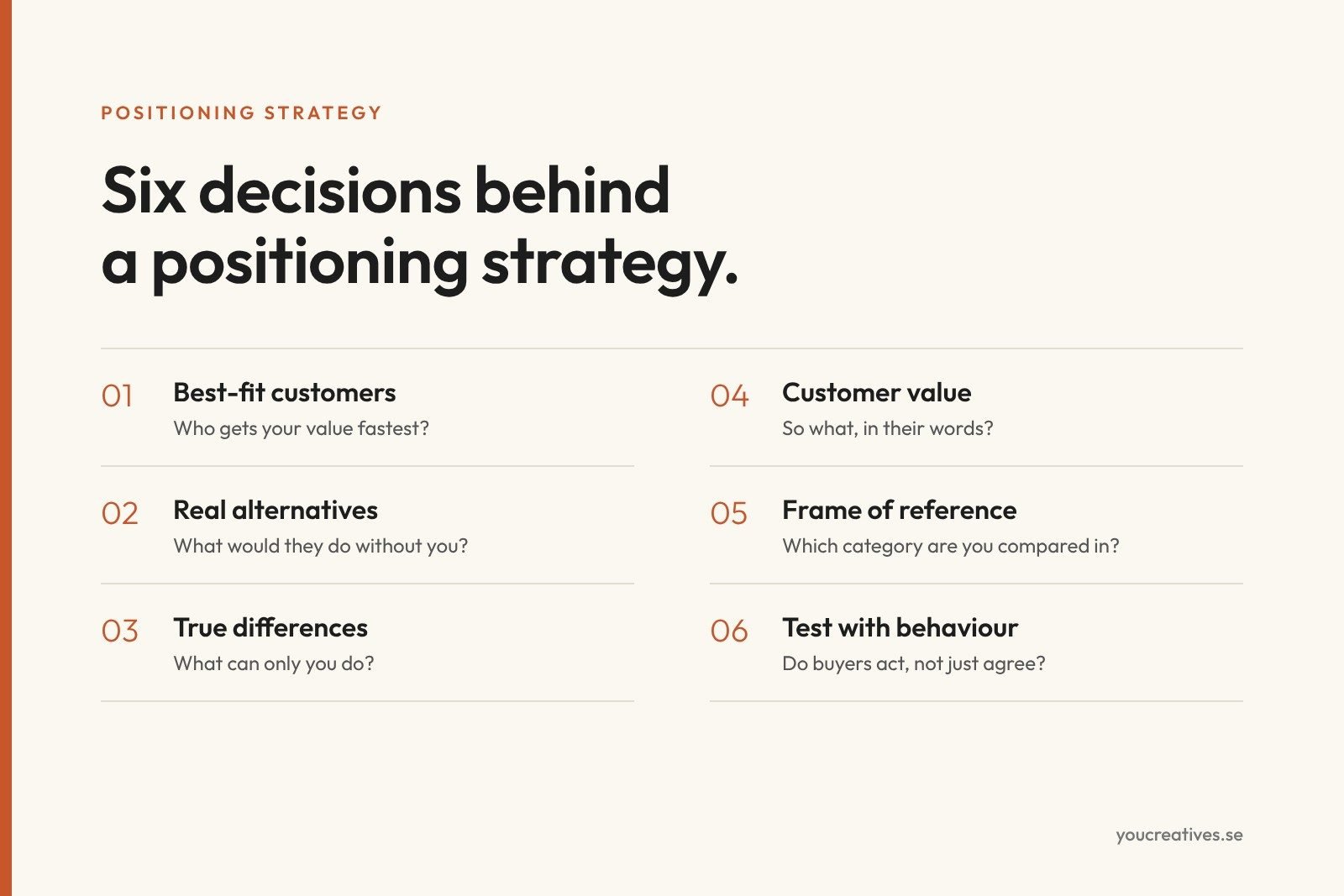
1. Start with your best-fit customers, not all customers
Look at the customers who understood your value quickly, bought without heavy persuasion, stayed and referred others. What do they have in common? Their situation, size, trigger or problem? Your positioning should be built around them, not around everyone who could possibly buy.
2. Map the real alternatives
Ask: if we didn’t exist, what would this customer do instead? The answer is often not a direct competitor. It might be a spreadsheet, an internal team, a freelancer, a consultant, or simply doing nothing. Those are the alternatives your positioning has to beat.
3. List what only you can do, honestly
Write down the capabilities you have that those alternatives don’t. Then remove anything that is simply expected in your category. “High quality,” “customer-centric” and “experienced team” are not differences. Every serious competitor claims them.
4. Translate each difference into customer value
For every capability, ask “so what?” until you reach something the customer actually cares about: time saved, risk reduced, revenue gained, confidence gained. A feature is not a position. The value it creates might be.
5. Choose your frame of reference
Decide which market category you want to be compared within. The category sets expectations before the buyer reads a single sentence of yours. The wrong category can make a strong product look average, or expensive.
6. Write it down, then test it with behaviour
A simple structure, adapted from Geoffrey Moore’s template in Crossing the Chasm:
For [target customer] who [need or trigger], [your company] is a [category] that [key benefit]. Unlike [main alternative], we [primary difference].
Then test it. Run customer interviews, try two versions of your homepage message, and listen to how prospects describe you back in sales conversations. Remember that compliments are not validation. “I like it” is weak evidence. Prospects booking a call, asking for a proposal or choosing you over an alternative are much stronger signals.
Common positioning strategy mistakes
- Trying to be for everyone. A position that fits every customer gives no one a reason to choose you.
- Treating category expectations as differences. If every competitor can say it, it is not positioning.
- Starting with the tagline. A good line expresses a decision. It can’t make the decision for you.
- Confusing positive feedback with validation. Watch what buyers do, not only what they say.
- Letting the founder and the company say different things. When a founder is known for one thing and the business sells another, buyers get confused about what they are actually buying.
Why your positioning now shapes how AI describes you
More buyers now ask AI tools to compare options before they ever contact a company. On 21 October 2026, Forrester published its 2027 B2B predictions under the headline that AI agents will influence 75% of B2B purchase decisions. The same release predicts that two-thirds of providers will lose deals because buyers cannot verify their claims.
That makes positioning more important, not less. AI tools summarise what is clearly and consistently said about you across your website, profiles and other sources. If your positioning is vague, the summary will be vague too. If it is specific and backed by proof, it is much easier for a person, or a machine, to explain why you are the right choice. I wrote more about this in GEO and AEO Explained for Founders.
A 10-minute positioning check
Before you change your website or your content plan, answer these five questions in writing:
- Who is the one customer group we are best for right now?
- What would they use if we didn’t exist?
- What can we do that those alternatives can’t?
- Why does that matter to the customer, in their words?
- Could a stranger explain what makes us different after reading our homepage for 30 seconds?
If you struggle with the fifth question, the gap is usually not in your expertise. It is in your positioning.
Frequently asked questions
What is a positioning strategy in simple words?
It is a clear decision about who you serve, what you are compared with and why you are the better choice for those customers. It guides everything you say and do in the market.
What is an example of a positioning strategy?
Volvo is one of the best-known examples. It built its position around safety, supported by real product decisions such as making the three-point seat belt standard in its cars in 1959.
What are the main types of positioning strategy?
Common types include attribute or benefit, price and value, competitor-based, category-based, customer segment and use-case positioning. Many strong positions combine two of them.
What is the difference between positioning and branding?
Positioning is the strategic decision about the place you want to hold in your customers’ minds. Branding is how you express and make that position recognisable through name, design, language and experience.
How often should you revisit your positioning strategy?
Revisit it when something important changes: you enter a new market, your best-fit customers change, a new type of alternative appears, or prospects keep misunderstanding what you do. Positioning should be stable, but not frozen.
Do small businesses and consultants need a positioning strategy?
Yes, perhaps more than large companies. A small business cannot outspend competitors on visibility, so being clearly understood by the right buyers is often its biggest advantage.
If you would like a second pair of eyes on your positioning, book a free 30-minute consultation. No pitch, just a clear look at where you stand.