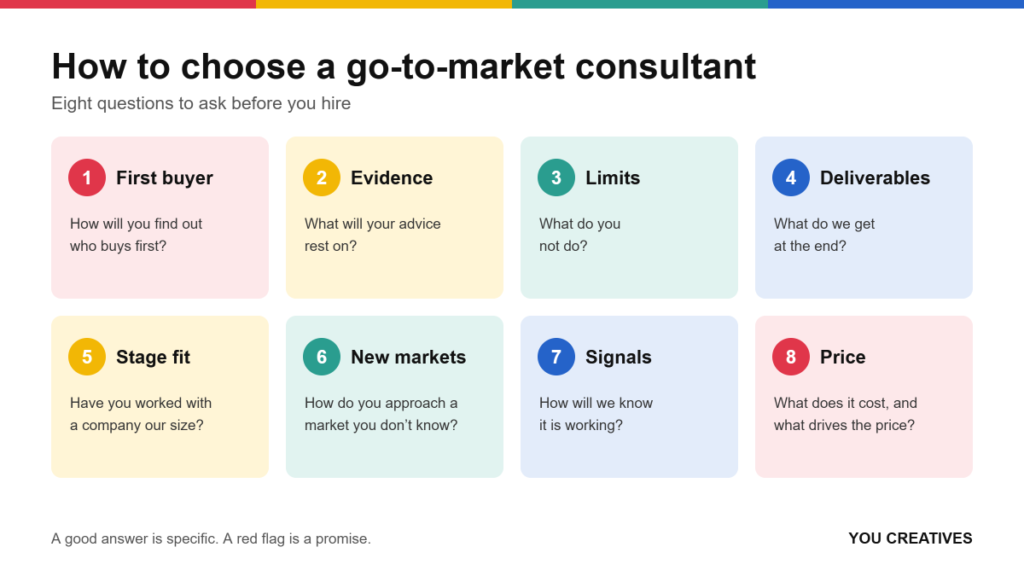
To choose a go-to-market consultant, check three things first: do they start with research on your buyers, will they tell you what they do not do, and is the output a plan your own team can run? The eight questions below test each of those, and show what a good answer sounds like.
What does a go-to-market consultant actually do?
A go-to-market consultant helps you decide who to sell to first, what to lead with and where to reach those buyers, before you spend on a launch. The work is strategy, not execution: research, positioning, messaging and a launch sequence. Our own page on working with a go-to-market strategy consultant explains the steps in more detail.
A consultant is not your only option. See where founders can get good go-to-market advice.
Where can founders get good advice on go-to-market?
Start with the people who would buy from you. Ten honest customer conversations will teach you more than any framework. After that, founders one stage ahead of you are useful, because they remember the mistakes. A consultant earns the fee when the open questions are strategic and you need structure, research capacity or a view from outside the company.
8 questions to ask a go-to-market consultant before you hire
1. How will you find out who our first buyer is?
This is the decision everything else depends on. If the first buyer is wrong, the message and the channel will be wrong too.
A good answer: They describe a research process: interviews with real buyers, a look at who already buys similar things, and a clear way to choose between segments.
A red flag: They already know your ideal customer after one call.
2. What evidence will your recommendations rest on?
Advice built on opinion sounds the same as advice built on evidence until the launch.
A good answer: They separate what they know from what they assume, and say how each assumption will be tested.
A red flag: Every answer starts with “in my experience” and ends there.
3. What do you not do?
Go-to-market covers research, positioning, pricing, sales, paid media and more. Nobody is strong at all of it.
A good answer: A plain list of what sits outside their work, and who they would send you to for it.
A red flag: They say yes to everything you mention.
4. What exactly do we get at the end?
You are paying for decisions and documents, so ask to see their shape before you sign.
A good answer: Named deliverables: a target segment, a positioning statement, core messaging, a channel plan and a launch sequence.
A red flag: “A strategy”, with no description of what is in it.
5. Have you worked with a company at our stage?
A plan for a funded scale-up does not fit a team of three. Stage matters as much as industry.
A good answer: They ask about your team size, budget and runway before they describe the plan.
A red flag: The same programme for every client, whatever the size.
6. How do you approach a market you do not know?
This matters most if you are entering a new country. A message that works in the US or UK does not always land the same way in Sweden or the wider Nordics.
A good answer: They plan to test the message with buyers in that market before you commit budget. See how to test messaging before launch.
A red flag: They assume what worked at home will translate.
7. How will we know if the strategy is working?
A launch produces noise. You need to agree in advance which signals count.
A good answer: A short list of early signals, such as replies, demo requests or sales conversations with the target segment, and a date to review them.
A red flag: Only reach, followers or impressions.
8. What does it cost, and what drives the price?
Price should follow scope: how much research is needed and how many segments or markets are involved.
A good answer: A clear price or range, and an explanation of what would make it higher or lower.
A red flag: No number until late in the process, or a price that cannot be explained.
How much does a go-to-market consultant cost?
It depends on scope, so compare what is included, not only the fee. As one reference point, we publish our own prices: the Validation & Go-to-Market Programme runs six to eight weeks and starts from 75,000 kr excluding moms, and a two-week Positioning & Visibility Audit starts from 12,000 kr. The details are on our pricing page.
Consultant, fractional CMO or agency?
Hire a consultant when the open questions are strategic. Hire an agency when the strategy is settled and you need execution at volume. A fractional CMO sits between the two and stays longer. We compare all three in go-to-market consultant, fractional CMO or agency.
Red flags when hiring a go-to-market consultant
- They promise a successful launch. Nobody controls the market.
- They start with tactics, such as ads or content, before asking who the buyer is.
- They do not want to talk to your customers.
- They cannot show what a finished piece of work looks like.
- They agree with everything you say.
Frequently Asked Questions
How do I choose a go-to-market consultant?
Choose one who starts with research on your buyers, is clear about what they do not do, and leaves you with a plan your own team can run. Ask the eight questions above and compare the answers, not the sales decks.
When is it too early to hire a go-to-market consultant?
It is too early if you have not yet spoken to any potential customers yourself. Do a first round of customer conversations, then bring in a consultant when you need structure, research capacity or an outside view.
Can a go-to-market consultant guarantee results?
No. A good consultant reduces uncertainty by giving you a clearer buyer, a tested message and a plan built on evidence. That improves your odds, but nobody controls the market.
Who can help my company build a go-to-market strategy for a new country?
Look for a go-to-market consultant who researches buyers in the country you are entering instead of reusing the plan from your home market. Buyer language, trust signals and competitors all change with the market.
If you are weighing up a launch and want a research-led second opinion, read how our go-to-market strategy consulting works, or book a free 30-minute consultation from that page.