What happens when the first “person” to read about your business isn’t a person at all?
That is no longer a hypothetical question. On 21 October 2026, Forrester published its 2027 B2B go-to-market predictions under the headline that AI agents will influence 75% of B2B purchase decisions.

AI agents are about to do the first round of B2B buying. They will search, compare and shortlist before anyone on the buyer’s side picks up the phone.
And here is the part I keep coming back to. The agent doesn’t decide on its own. People still decide. They just arrive with a shortlist someone else drafted.
So your positioning now has three jobs. It has to be clear enough for an agent to match. Specific enough to verify. And human enough to survive the conversation that follows.
What Did Forrester Predict for B2B Go-to-Market in 2027?
According to Forrester’s announcement, business buyers will increasingly use AI agents across the buying process, from supplier discovery and information gathering to contract-renewal analysis.
Three predictions stood out to me, because each one is really about trust:
- Buyers will double their human interactions to validate AI-generated recommendations. AI cannot fully judge fit, feasibility, trust or accountability, so buyers will want to talk to provider teams and trusted third parties such as analysts, customer references and partners.
- Two-thirds of providers will lose deals because buyers cannot verify their claims. Forrester says go-to-market teams will need credible, consistent proof points that AI tools can index and validate.
- Most CMOs will cut programs or accept reduced capacity after overestimating AI gains, with as many as 25% of marketing roles eliminated in anticipation of productivity that fails to arrive.
Forrester also notes that truly autonomous buying will stay concentrated in high-volume, low-risk, repeatable purchases. Its chief research officer, Sharyn Leaver, put the challenge simply: leaders will need to “make deliberate choices about what to automate and where human judgment still matters”.
I find that reassuring. The machines are getting faster. But the moment of trust is still human.
What Does an AI Agent Actually Do in a B2B Purchase?
Think of the agent as a very fast, very literal researcher.

In Forrester’s description, it finds suppliers, gathers information, synthesises what providers claim and fact-checks it. That builds on what Forrester already reported in The State Of Business Buying, 2026: generative AI search is the starting point for B2B buyers, and the typical buying decision involves 13 internal stakeholders and nine external influencers.
Put simply, a machine now writes the first draft of your shortlist. Then a group of people decides whether to believe it.
I wrote about the research side of this in how B2B buyers use AI to research you. The agent shift raises the stakes. Because the agent doesn’t just read about you.
It compares you.
Why Is This a Positioning Problem First?
Positioning is the place you occupy relative to the alternatives a buyer is already considering. April Dunford’s widely used framework breaks it into five parts: competitive alternatives, unique attributes, the value those attributes create, the customers who care most and the market category you choose to compete in.
Now look at what an agent asks. What are the options? How do they differ? Which one fits this buyer?
Almost the same questions.
If your answers are vague, the agent has nothing specific to match. If your claims can’t be checked, the buyer has nothing to trust. Either way, you drop off a list you never knew you were on.
This is why I don’t believe “more content” is the answer. A company with an unclear position that publishes more simply gives the agent more confusing material to summarise. Clarity has to come first. The fix starts with deciding what you are known for, then making it easy to verify.
How Should You Position When AI Agents Do the First Round?
After ten years in consumer and market research, I’ve learned that people rarely choose the “best” option. They choose the one they understand and trust. Agents don’t change that. They just make it visible earlier.
This is the sequence we use at You Creatives:
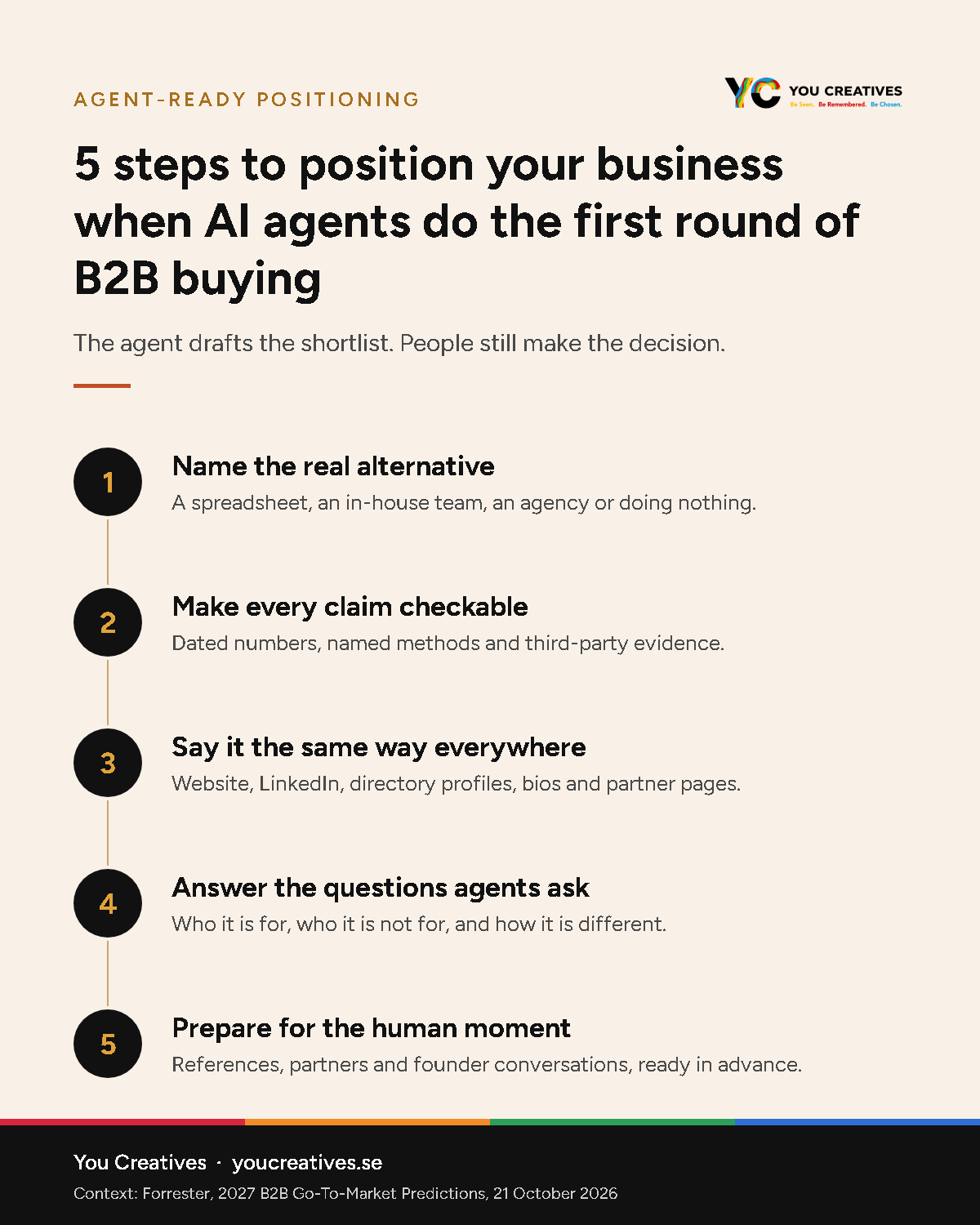
- Name the alternative you are really compared against. Often it isn’t a competitor. It’s a spreadsheet, an in-house team, an agency or doing nothing. Agents compare options; make sure yours is framed against the right one.
- Turn every claim into something checkable. Replace “results-driven” and “industry-leading” with dated numbers, named methods, specific client situations and third-party evidence. Credibility isn’t built by calling yourself an expert. It’s built when people can see the proof.
- Say it the same way everywhere. Your website, LinkedIn, directory profiles, bios and partner pages should describe you consistently. Agents and AI search tools blend sources, and inconsistency reads as uncertainty.
- Answer the questions buyers and agents actually ask. Who is this for? Who is it not for? How is it different from the alternative? What does it cost to switch?
- Prepare for the human moment. Buyers will seek more human validation, so line up references, partners and founder conversations before you need them.
What Changes in Your Go-to-Market Strategy?
Go-to-market used to be mostly about reach. Which channels. How much budget. How many touches.
In an agent-mediated market, it is just as much about verification. Three shifts follow:
- Your content becomes a proof layer. Every important claim on your site should have evidence next to it, easy for both people and machines to find.
- Sales and founder conversations become validation. The meeting is less about introducing yourself and more about confirming what the buyer, and their agent, already believe.
- Human expertise becomes the differentiator, not the cost to cut. Forrester’s warning about CMOs overestimating AI gains is a reminder not to remove exactly the judgment buyers will be looking for.
For the full sequence, see our B2B go-to-market framework and what go-to-market strategy actually is.
The order of the work matters more in an agent-mediated market than it did in a human-only one. The sequence we run engagements through, the Authority Engine™ — market research, business positioning, founder positioning, messaging, strategic storytelling, content strategy, visibility, authority, growth — exists because content produced before the position is settled cannot be verified, and a position with no evidence attached to it cannot be cited by anything, human or machine.
What Does This Mean for Smaller Companies and Advisors?
The good news? It can be an advantage.
Large vendors often describe themselves in broad, safe language. A founder-led company or an independent advisor can be far more specific about who they serve, what they won’t do and what they have actually delivered.
Specificity is exactly what helps an agent match you. And direct access to experienced people is exactly what buyers will look for when they validate.
The risk is the opposite. A small firm with a vague position and little written proof gives the agent nothing to work with. A reputation that travels only by word of mouth stays invisible in the first round.
A 30-Minute Positioning Check for an Agent-Led Market
- Write your position in one sentence: what you do, who it’s for and what you deliberately exclude.
- List your three main claims. Next to each, write the evidence a stranger could verify.
- Ask two or three AI tools to describe your company, and compare their answers with your own sentence.
- Check your top three third-party profiles for outdated descriptions.
- Name two customers or partners who could vouch for you if a buyer asked tomorrow.
If any of these feels hard, that is where the work is. Before you launch anything new, it is worth testing your positioning with real buyers.
Frequently Asked Questions
Will AI agents replace human B2B buyers?
Not according to Forrester. It expects truly autonomous buying to stay concentrated in high-volume, low-risk, repeatable purchases, and predicts that buyers will increase human interactions to validate AI recommendations.
What is agent-ready positioning?
Positioning that is specific enough for an AI agent to match you to the right buyer, consistent across every source it reads and backed by proof that can be verified.
How do I make my company’s claims verifiable?
Attach evidence to every important claim: dated numbers, named methods, specific client outcomes, third-party reviews or references. Then keep them consistent across your website and external profiles.
Does this matter for small companies?
Yes, and it can favour them. Smaller companies can be more specific and offer direct access to experienced people, which is what agents need to match and what buyers need to trust.
The tools will keep changing. What people need in order to trust you won’t.
If you’d like to see how your positioning looks to an AI agent, and to the people who check its work, our go-to-market strategy consulting starts exactly there. Book a free 30-minute consultation. No pitch, just a clear look at where you stand.